


Crude oil processing Step by step to a quality product
MiRO manufactures petroleum products from crude oils and other input materials in the quantity and quality required by our customers and to supply consumers. Innovations and investments ensure timely adaptation to market changes and continuous improvement of efficiency and energy consumption.
Crude oil processing is a multi-stage process that runs continuously around the clock. Before the wide range of end products is created, the mineral oil must pass through various production facilities and a large number of components must be obtained. From these, the desired finished products are finally mixed, sometimes with the addition of quality-improving additives.
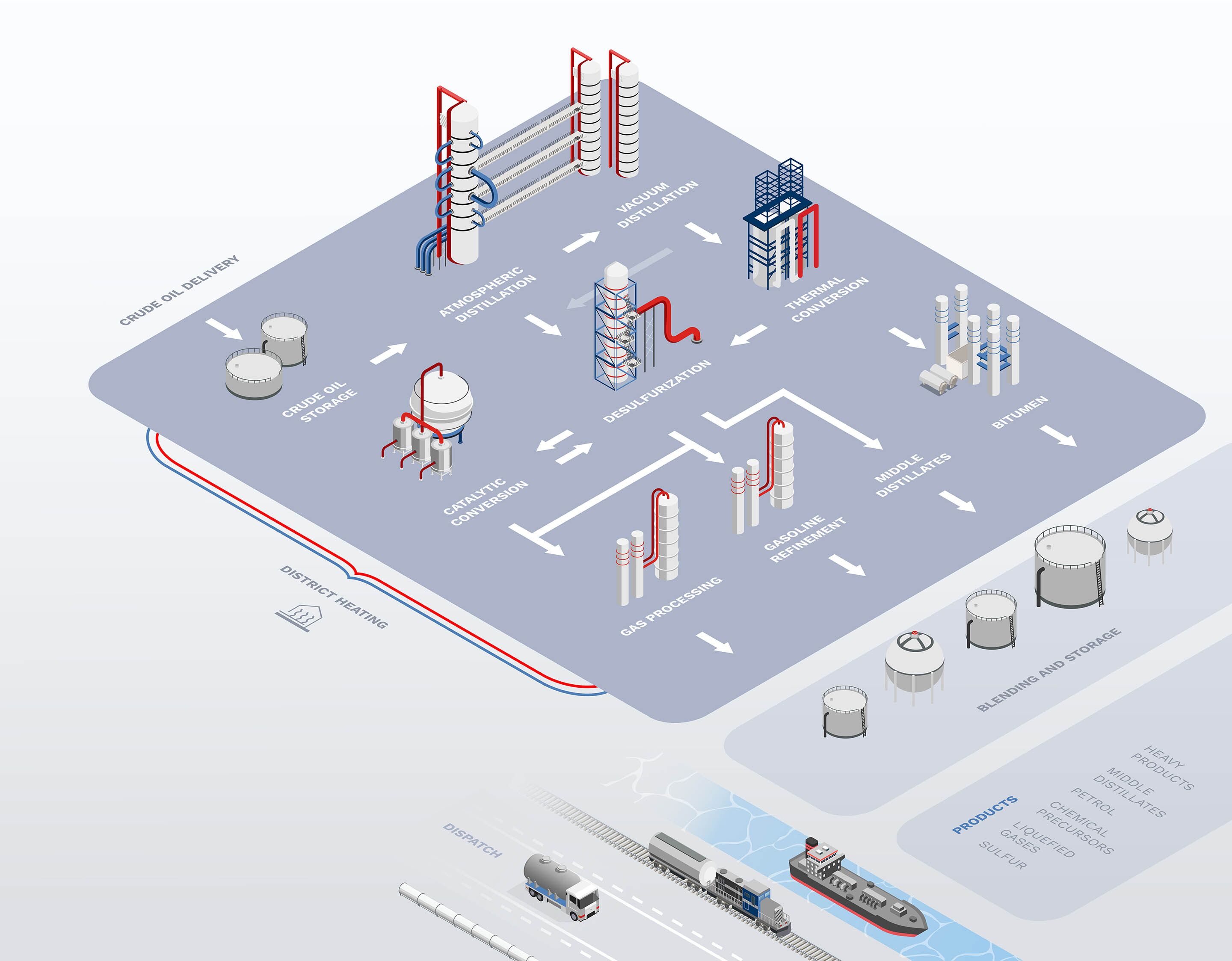
In the following, the process of crude oil processing is presented in a highly simplified way.
Raffiniert Understanding a Refinery
-
Crude oil delivery
The crude oil is transported by ship by our shareholders to the port of Trieste, Italy. From there, it will continue its journey via Transalpine Ölleitung GmbH (TAL) to Karlsruhe, about 740 km away. Not all crude oil is the same. A distinction is made between the types of crude oil according to their specific gravity, their sulphur content and their chemical composition. MiRO receives around 60 to 80 crude oils per year for processing. In total, MiRO can process 250 different types of crude oil from five different continents. One third of the crude oils come from North Africa. Another third of crude oil comes from countries of origin in Eastern Europe/Central Asia and the Middle East.
-
Crude oil storage
The crude oils are stored separately from each other in a total of 19 crude oil tanks with a capacity of around 730,000 m3 according to the sulphur content criterion.
-
Atmospheric distillation
Atmospheric distillation is the first processing step. The crude oil is heated by heat exchangers, heated to approx. 350/380 °C in tube furnaces and separated into liquefied petroleum gas, petrol, diesel and light heating oil in the atmospheric distillation column according to boiling ranges. The heavy residue is then distilled again under vacuum.
The intermediate products obtained in this way must be further processed in downstream plants. Desulphurisation and refinement play a decisive role in this with regard to the mixture of high-quality finished products.
-
Vacuum Distillation
The heavy residue from atmospheric distillation is distilled again under vacuum. This produces vacuum gas oil and vacuum residue.
The intermediate products from vacuum distillation must be further processed in downstream plants. Desulphurisation and refinement play a decisive role in this with regard to the mixture of high-quality finished products.
-
Thermal Conversion
The heavy residues from crude oil distillation are "cracked" again at high temperatures and pressures in so-called conversion plants, i.e. the long hydrocarbon chains are split into several shorter ones. In this way, lightweight and thus marketable products are created. MiRO has two large conversion plants – one thermal and one catalytic. The thermal conversion system is the Delayed Coker. Here, thermal cracking produces two-thirds gasoline and middle distillate components for the production of heating oil and about one-third petroleum coke for use in the cement industry.
-
Desulfurization
Sulphur compounds are harmful to the environment, engines and heating oil burners in many ways. They are contained in mineral oil products and are released during combustion. That is why the legislator has set strict limit values. Before mixing the intermediates into finished products that meet specifications, the sulphur must therefore be removed. This is done catalytically with hydrogen. The sulphur compounds obtained in this way are then processed into elemental sulphur in the sulphur recovery plants, which is then used industrially elsewhere (e.g. rubber tyres, artificial fertilisers). We produce around 250 t of sulphur every day.
-
Catalytic conversion
The heavy residues from crude oil distillation are "cracked" again at high temperatures and pressures in so-called conversion plants, i.e. the long hydrocarbon chains are split into several shorter ones. In this way, lightweight and thus marketable products are created. MiRO has two large conversion plants – one thermal and one catalytic.
In the catalytic cracker, the vacuum distillate produced in vacuum distillation is converted into higher quality products by chemical reactions with the help of a circulating catalyst. The main production is gasoline (with more than 50% of the main product) and liquefied petroleum gas (propylene and butylene).
-
Gas Processing
In gas processing, the liquefied gas is separated into propylene, propane and butane by distillation. Propylene is supplied to the chemical industry as a valuable feedstock.
-
Gasoline refinement
The gasolines from crude oil distillation are not optimally suited as fuels for engines; they tend to "knock". Refining in our reformer plants and isomerization involves increasing the octane number of the desulfurized gasoline components so that these components can later be mixed into knock-resistant engine gasoline. The octane number describes the resistance to spontaneous combustion of fuels.
-
Middle distillates
Middle distillates are products obtained during the refining of crude oil in the "medium" boiling range. These include diesel and light heating oil. These account for around 44% of the MiRO product range.
-
Bitumen
Bitumen is a heavy, viscous product, which we obtain from the residue of suitable crude oils. Bitumen is used, for example, as a binder in asphalt for road and hydraulic engineering and as a sealing material in the construction industry.
-
Blending and storage
The finished products are created by mixing individual components in an in-line blending process. For example, the basic petrol mixture according to DIN standards consists of 8 to 10 petrol components. In-line blending is a mixing process in which individual components are simultaneously fed from different component tanks into a common main stream in a pipeline and mixed by vortex movements to form a finished product of constant quality. The finished product is then sent to a product tank for storage.
Our tank farm is the largest in Europe. More than 350 tanks and storage tanks can hold around 4.7 million m3 of crude oil, semi-finished and finished products.
The tanks differ in their design: In floating roof tanks, the roof on pontoons lies directly on the tank contents in order to avoid outgassing losses in the case of volatile substances such as crude oil and gasoline. Middle distillates such as light heating oil or heavy products such as bitumen are stored in fixed roof tanks with domed roofs. The tanks for storing the heavy, viscous products are insulated and heatable. There are also so-called pressure vessels. These are spherical or cylindrical tanks in which liquefied gases such as butane, propane and propylene are stored.
The tanks are surrounded by protective walls. They are located in so-called tank cups, which are impermeable to seepage and prevent hydrocarbons from penetrating the ground in the event of leaks. The protective walls are so high that the entire contents of a tank could be collected.
-
Product
Heavy Products
Heavy products include bitumen, coke, calcinate and heavy heating oil.With our bitumen production, we could cover around a third of Germany's demand, but our shareholders also transport bitumen from our production to nearby France. Bitumen is mainly used in road construction as a binder for asphalt; however, it is also widely used in the construction industry, for example for waterproofing roofs. Coke is used as a fuel in the cement industry and calcinate for industrial electrode production.
Middle distillates
Middle distillates are products obtained during the refining of crude oil in the "medium" boiling range. These include diesel and light heating oil. These account for around 44% of the MiRO product range.
Petrol
We produce fuels for vehicles with gasoline engines in the grades Eurosuper E10 and E5 as well as Superplus. These differ from each other in terms of octane number and bioethanol content.
On average, every 3rd litre of petrol refuelled in Germany comes from our refinery. But this is only an average value. If you fill up with petrol in the southwest, you are very likely to have our fuel in your tank. With a share of one third, gasoline is the strongest product in our product range in terms of volume.
Chemical Precursors
We produce various raw materials for the chemical industry (e.g. naphtha, propylene, benzene).
Propylene, for example, travels by pipeline to Ludwigshafen and is used there in a large chemical plant for the production of plastics.Liquefied gases
Propane and butane are used for heating in households and businesses – and in the case of butane also when camping.
Sulfur
Crude oil naturally contains sulfur. In order to be able to adjust the sulphur-free product qualities, the intermediate products must be desulphurised. This is done catalytically with hydrogen. The sulphur compounds obtained in this way are then processed into elemental sulphur in the sulphur recovery plants, which is then used industrially elsewhere (e.g. sulphuric acid, artificial fertilisers, dyes).
-
District heating
We feed so-called low-temperature waste heat from our production processes with a heat output of 90 MW into the municipal district heating network. Around 60% of Karlsruhe's district heating comes from our refinery and supplies over 40,000 households.
-
Dispatch
Our shareholders organize the shipment of the products manufactured by MiRO to the consumer on various transport routes. 61% of our products are transported by road by tanker and thus remain in the region. 25% leave our plant by ship via the Rhine, another 13% by rail and 1% by pipeline (figures from 2023).
Our products Diversity for life
Our products are as diverse as life. We encounter mineral oil every day – not least in our own four walls, products based on mineral oil develop their full potential for a better quality of life.
-
Garden
Mineral oil is an important raw material for children's play equipment (e.g. slides) and children's toys (e.g. buckets and shovels for the sandpit).
-
Chemical plant
Products from the refinery are important input materials for the chemical industry, e.g. plastics (yoghurt cups, drug blisters, foils, casings, etc.) are made from propylene and sulphur, which is a by-product of the desulphurisation of crude petrol, is used in chemistry to produce sulphuric acid or artificial fertiliser.
-
Gas station
The majority of the private car fleet is still vehicles powered by fossil fuels. At petrol stations, fuels for vehicles with petrol engines are usually available in the qualities Eurosuper E10 and E5 as well as Superplus. These differ from each other in terms of octane number and bioethanol content.
-
Construction site vehicles
Construction vehicles such as excavators, bulldozers, concrete mixers and other vehicles in the field of heavy-duty logistics will need diesel for the foreseeable future.
-
TRUCK
Heavy-duty transport will be dependent on diesel fuel for a long time to come.
-
District heating
Low-temperature waste heat collected in the refinery process with state-of-the-art heat exchangers is fed into the municipal district heating network and heats many thousands of households.
-
Street
Bitumen, a heavy product from the refinery and the oldest mineral oil product of all, is used as a binder for the production of road asphalt. However, bitumen is also widely used in the construction industry, for example for waterproofing roofs.
-
Boiler room
Many households continue to heat with oil or gas.
-
Bathroom
Many cosmetics and vital medicines are based on mineral oil.
-
Kitchen
Mineral oil is the basis for cleaning agents, grill lighters and plastic kitchen utensils such as lunch boxes or cling film.
-
Wardrobe
Mineral oil is an important raw material for clothing made of state-of-the-art textile fibres, as well as for sports shoes.
-
Living room + office
Mineral oil is also found in screens, CD cases, wall paints, floor coverings and carpets.
-
Roof
Solar collectors on the roof cannot do without mineral oil-based components.

Our product range At a glance
| Products | Use |
|---|---|
| Propene (propylene) | Raw material for the chemical industry (e.g. flexible and rigid foams, acrylic fibres, synthetic rubber, impact-resistant plastics) |
| Propane | Heating in households, leisure (e.g. camping) and businesses |
| Butane | Heating in households and businesses |
| LPG | Mixture of propane and butane for motor vehicles |
| Light gasoline | Raw material for chemical industry |
| Eurosuper E10 | 95 (oz) octane fuel and up to 10% bioethanol for gasoline motor vehicles |
| Eurosuper E5 | 95 octane (oz) fuel with up to 5% bioethanol for gasoline motor vehicles |
| Superplus | 98 octane fuel (oz) for motor vehicles with gasoline engines |
| Diesel fuel | Fuel for motor vehicles with diesel engines |
| Light fuel oil | Heating in households and businesses |
| Heavy fuel oil | Electricity and heat generation in the industrial sector |
| Bitumen | Road construction (asphalt), sealing material (e.g. roof waterproofing membranes), insulating material, corrosion protection (e.g. protective coatings for automotive underbodies) |
| Kalzinat | Electrodes for the aluminium industry |
| Coke | Fuel for industry (e.g. cement industry) |
| Sulfur | Raw material for the chemical industry (e.g. car tires) |
| District heating | Low-temperature waste heat for the municipal district heating network |