


Our Responsibility
Through our energy products, the Southwest stays agile and “alive”. We offer exciting and forward-looking jobs and produce a wide range of products that the market and thus our customers need every day. This makes us an integral part of society. As such we aim to actively participate in shaping the sustainable development of the region in which we work and live.
Safety and environmental protection are firmly anchored in our corporate philosophy and business principles, they are central responsibilities of our company and are among our primary corporate goals.
As a responsible part of society, we also make contributions to sustainable development outside our core business – for example through our tax revenues, donations or cooperation with schools and universities.
Supply & Economic Power
We play a central role in the security of supply in the southwest. Around 10 million people depend on fuels or heating oil from our production every single day and are reliably supplied by us. In addition, we supply 60% of the district heating for the city of Karlsruhe. This gives us a huge public responsibility, and we are proud to fulfil this in the most reliable way. This also makes a part of the critical infrastructure of the Federal Republic of Germany.
As one of the largest employers and training companies in the Karlsruhe region, we are also an important economic factor and see ourselves as an active player in the shaping, strengthening and further development of the Karlsruhe TechnologyRegion.
Safety & Health
In close cooperation with the authorities, we are continuously working to eliminate any impairment or risk to our neighbours, employees and the environment.
We continuously monitor and analyse new technical developments in order to operate our plants in compliance with the highest environmental and safety standards and to minimize emissions.
We take our responsibility for the safety of our employees and the people around us very seriously and ensure that all aspects of occupational health and safety are always adhered to. To ensure the safety of our employees, we use best practices and clearly structured workflows. Regular training, safety inspections, work permits and special campaigns focussing on occupational and plant safety are firmly integrated into our everyday life. In addition, we continuously verify the safety and integrity of our production facilities. We are supported in this by our internal management system, which defines highest standards and procedures for safety, environmental protection and health protection.
As the operator of a refinery, we are obliged by the Major Accidents Ordinance (12th BImSchV) to implement measures to prevent accidents, as well as to prepare safety reports, alarm and hazard prevention plans and to inform the public in the event of incidents.
For the correct response and behaviour in case of an emergency, we ask you to adhere to the specifications of the brochure "Correct behaviour in the event of an emergency ".
Event prevention is a central part of our overall safety philosophy and is supported by extensive safety precautions and investments in state-of-the-art protective equipment and technologies. Thanks to our state-of-the-art plant fire brigade and close cooperation with the Karlsruhe professional fire brigade and other neighbouring companies, we are well prepared and ready for action for any eventuality at any time on a 24/7 basis.
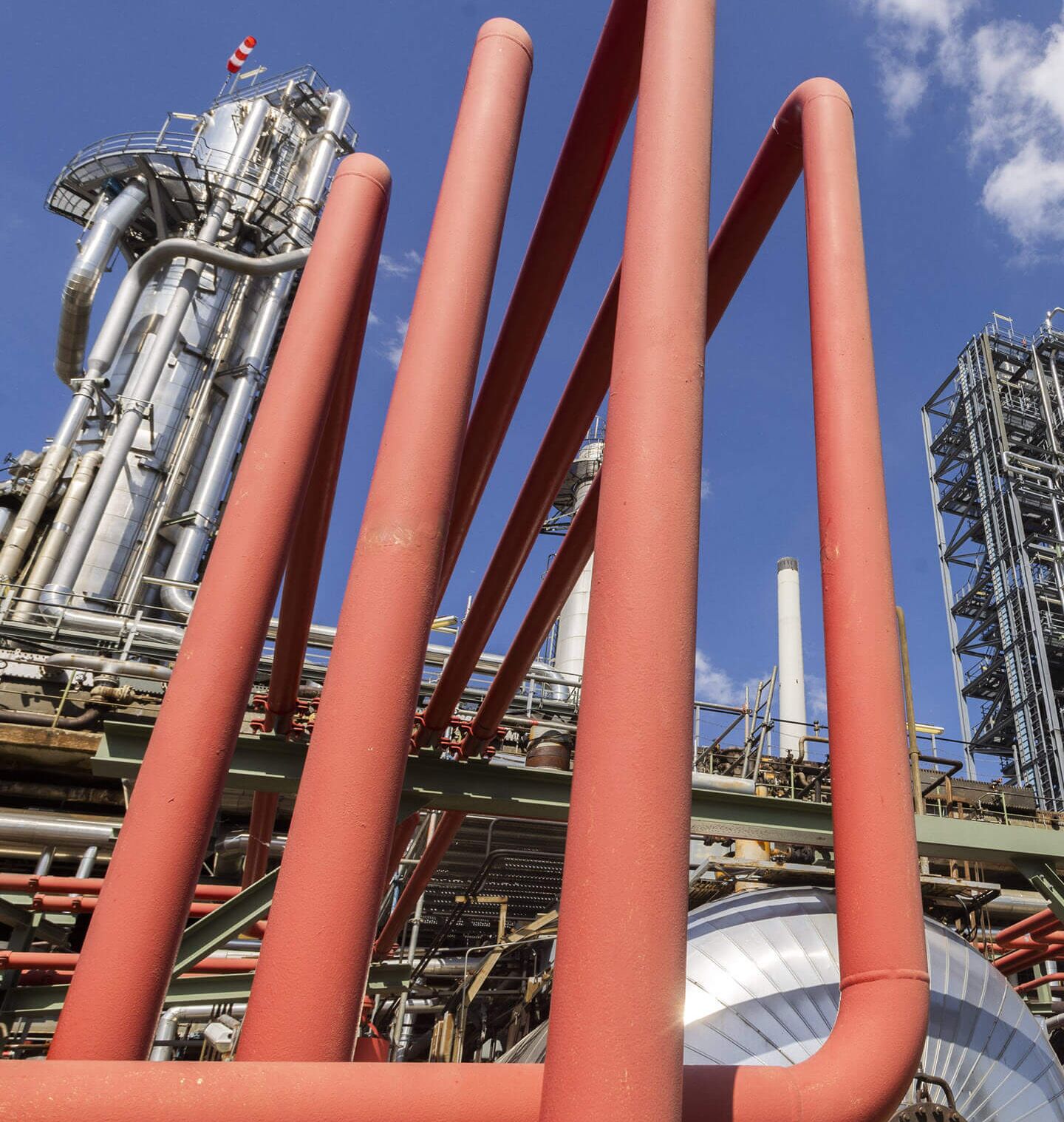
Environment & Energy Efficiency
At MiRO, we attach great importance to environmentally conscious thinking and acting and are committed to the environmentally friendly production of our products. To minimise the potential impact on the environment and our neighbourhood, we rely on structural and constructive measures. Measures for air pollution control, the protection of water and soil, noise protection as well as waste prevention and treatment have highest priority for us.
MiRO is a company certified according to EN ISO 14001 (environmental management system) and thus guarantees environmentally friendly operational management. In this way, we demonstrably meet the high demands placed on our company and our environmental performance. MiRO is one of the most energy-efficient refineries in Europe and a company certified according to DIN EN 50001 (energy management system).
In order to conserve resources, the environment and the climate, it is important to consume energy in the most efficient way. We strive every day to further improve our already best-in-class energy efficiency and to further reduce CO₂ emissions.
Our resources are used in the best possible way, so that we are largely energy self-sufficient. Combined heat and power generation in the plant's own power plants makes a significant contribution to this. Most of the electricity consumed internally by MiRO is generated by our combined heat and power (CHP) turbines, which significantly reduces the consumption of primary energy.
Since the commissioning of the second expansion stage for district heating in 2015, MiRO has been supplying up to 90 MW of heat to the district heating network of Stadtwerke Karlsruhe. This supplies more than 40,000 households with heat, and at the same time avoids over 100,000 tons of CO₂ emissions (1 t CO₂ is roughly equivalent to a flight from Frankfurt to Lisbon).

Quality
MiRO is certified according to DIN EN ISO 9001 (quality management system). The quality of our products in accordance with specifications is ensured by state-of-the-art process controls, extensive control mechanisms supported by state-of-the-art laboratory analysis technology, a very high level of training of our employees, as well as regular product, process and system audits, which help us to keep our management system and our corporate organization up to date at all times.

Reliable neighbour in the region Commitment to partnership
We regularly exchange information with our neighbours and the surrounding communities around our location. We appreciate and maintain this intensive contact very much. Providing transparency, communicating openly and looking for solutions together is a critical concern for us. We also actively support associations, social projects and initiatives in the region.
MiRO is an attractive employer in Karlsruhe and the region. The promotion of education and training is a high priority for us. We are a partner in the IHK program "School and Business" and participate in various working groups of the Baden-Württemberg chemical associations.
We have a close partnership with the Karlsruhe Institute of Technology (KIT). Many of our employees completed their studies at the KIT and there is
regular intensive exchange in the context of excursions, internships, theses, or joint projects.
As a shareholder of the Karlsruhe TechnologyRegion (TRK) we are committed to the further development of the region and thus help shaping future-relevant topics such as mobility, energy and infrastructure.
MiRO tomorrow Refinery of the future
Sustainability and climate protection already play an important role for us today. As part of society, we want to actively shape and drive forward the sustainable development of the region in which we work and live. With projects such as district heating and the continuous reduction of internal energy consumption, we are already making a valuable contribution to reducing CO2 emissions.
However, it is also clear that the energy supply of tomorrow will be different from today to actively address climate change and achieve the climate targets. We see ourselves as a partner in the energy transition, we take responsibility, and we actively shape the necessary transformation.
In addition to electrification, the use of hydrogen (green, blue, etc.) as well as of so-called hydrogen derivatives such as methanol or ammonia will play a decisive role in replacing fossil fuels in the future.
MiRO is already involved in these forward-looking topics. Together with a wide variety of partners from research and science, industry and associations, we are working on several projects pointing towards a more sustainable future.

Together with project partners, for example, we are investigating how so-called e-fuels, i.e. synthetic sustainable fuels made from renewable raw materials, can be produced without fossil crude oil through the ReFuels – Rethinking Fuels (www.refuels.de) project, how these production methods can be integrated into the refinery's existing infrastructure in the best possible and efficient way, thus shaping a transformation into a sustainable future
In addition, we are involved in the Ref4Fu (www.ref4fu.de) project, which aims to develop, validate and evaluate sustainable refinery concepts that can meet future demand for renewable liquid fuels.
We are also involved in the InnoFuels project (Innofuels) in setting up a platform for networking, further developing and defining framework conditions for the ramp-up of electricity-based fuels and advanced biofuels.
Finally, we are intensively involved in the H2iPortKA (h2iportka) project with various partners of the Karlsruhe TechnologyRegion, in which a future hydrogen infrastructure is being modelled to support the market ramp-up of green hydrogen through targeted networking and transfer offers along the value chain.
In addition, MiRO is actively involved in the planning and preparation of a national hydrogen supply as well as the procurement of green energies from favourable locations (H2 Roadmap BW).
The path towards a greener future of the MiRO refinery site is linked to a number of prerequisites critical for success: On one hand, it is about the availability, cost-competitiveness and usability of sustainable raw materials as well as a corresponding transport infrastructure (pipelines and power grids). On the other hand, however, the plannability and feasibility of larger projects must also be effectively supported by appropriate reliable regulatory frameworks.
To achieve the climate targets, however, de fossilisation must not be limited to the use of raw materials and the products manufactured. A part of the solution, and just as important, is the reduction and avoidance of process emissions from the production processes. The by far quickest and cost-effective way to reduce CO2 process emissions is to store such CO2 in the ground (CCS) and use it by capturing it directly at the point sources of the industrial plant to produce synthetic raw materials (CCU).
The climate goals can only be achieved through an optimised interaction of all available options. However, no one can yet predict exactly which technologies will prevail and prove themselves on the market in the long-term and to what extent. Reliable regulatory frameworks are essential for the required huge investments. The emerging transformation of the energy market is a major challenge. Shaping a climate-neutral future can only be achieved through collaboration of industry, politics and society by setting ambitious goals, focusing all efforts on achieving these goals and pooling all available expertise.
